After years of rapid innovation in Large Language Models (LLMs), the next seismic shift in artificial intelligence is already here – the age of intelligent agents. Unlike traditional LLM-based chatbots that respond to prompts, intelligent agents plan, reason, remember, and act autonomously, executing multi-step tasks, using tools, interacting with enterprise systems, and making real-time decisions.
This evolution isn’t incremental. It’s architectural.
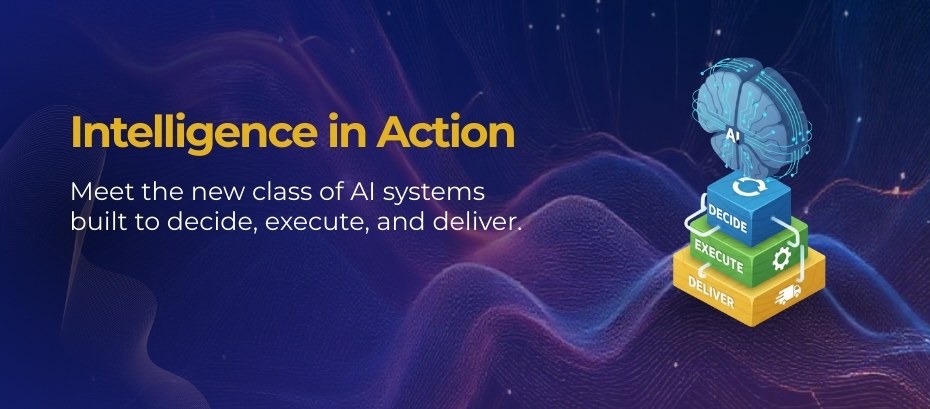
Today’s intelligent agents integrate advanced reasoning, memory, and tool use to function as autonomous systems capable of completing complex goals with minimal human intervention. Think of them as AI employees, ones that can onboard new hires, resolve customer issues, orchestrate sales workflows, write code, monitor IT systems, or build a market report end-to-end.
This blog explores how intelligent agents work, why they transcend LLM limitations, and how enterprises are already deploying them at scale.
Understanding Intelligent Agents
Traditional LLMs, no matter how advanced, are fundamentally reactive. They answer. They don’t take action. Intelligent agents break this boundary. They don’t just respond to prompts; they proactively pursue objectives, make decisions, and execute tasks on your behalf. By combining planning, memory, and tool use, agents operate more like autonomous digital teammates than conversational systems.
What Makes an AI Agent “Agentic”?
Across the evolving landscape of AI research and emerging agentic frameworks, three core pillars have come to define how intelligent agents operate:
#1. Planning & Goal Initialization
Planning is what separates an intelligent agent from a simple conversational model. While an LLM can provide an answer to a question, an agent can take a high-level objective and translate it into a structured, multi-step plan. It begins by understanding the user’s overarching goal, then breaks that goal into smaller, actionable tasks through a process called task decomposition.
As the agent gathers more information, either from user input or from external tools, it continuously updates its plan, adjusting its approach much like a human problem solver would. This ability to set goals, map out a workflow, and iteratively refine its path is what transforms an LLM from a reactive responder into a goal-driven, autonomous system capable of completing end-to-end tasks.
#2. Short- and Long-Term Memory
Memory gives intelligent agents the ability to maintain continuity, personalize interactions, and learn over time—something traditional LLMs cannot do on their own. Short-term memory enables the agent to hold context within the current session, allowing it to understand follow-up questions, maintain conversation flow, and reference previous steps in a task.
Long-term memory, often powered by Retrieval Augmented Generation (RAG), enables the agent to store and retrieve historical data, including user preferences, past interactions, learned rules, and domain-specific knowledge. This dual-memory architecture not only makes the agent more effective but also more adaptive, enabling it to refine its behaviour, tailor its responses, and perform tasks with greater accuracy and familiarity with each interaction.
#3. Tool Use & Agentic Reasoning
Tool use is the defining capability that gives agents real-world power and autonomy. Instead of relying solely on the information baked into their training data, agents can tap into external resources—APIs, enterprise systems like Salesforce or Workday, databases, web searches, user applications, and even other agents. This means they can fetch live information, perform transactions, trigger system workflows, send notifications, or run business logic instantly and independently.
Once an agent receives the output from these tools, it uses agentic reasoning to update its understanding, refine its strategy, and decide the next best action. This continuous loop of sensing (through tools), reasoning (based on outputs), and acting (via additional tool calls) allows the agent to operate with a level of autonomy that mimics human decision-making. Together, tool use and reasoning give agents the ability to function as active participants in digital ecosystems—not just observers.
How Agents Move Beyond the Limitations of LLMs
Large Language Models have transformed how we interact with information, but even the most advanced LLMs remain fundamentally constrained. They can generate, summarize, and explain, but their abilities stop at the edge of their training data. They cannot verify facts, update themselves with live information, or take real action without human direction.
Intelligent agents change this paradigm entirely. By integrating planning, memory, and tool use, they evolve from passive responders into autonomous digital workers. Here’s how they overcome the major boundaries of traditional LLMs.
Tool Use Solves the Knowledge Problem
LLMs know only what they were trained on. If a fact has changed—pricing, events, inventory, regulations—they have no way to confirm it. Agents, on the other hand, can step outside their static knowledge base.
They can perform web searches, call APIs, execute database queries, and even collaborate with other agents. This gives them the ability to gather up-to-date information independently, verify assumptions, and ground their reasoning in real-world data.
Planning Converts Short-Form Reasoning Into Multi-Step Autonomy
Ask an LLM a question, and you get an answer. Ask an agent to achieve a goal, and it builds a plan.
Agents can:
- Research a topic
- Pull data from multiple systems
- Generate structured reports
- Send emails
- Set reminders
- Update enterprise tools like CRMs or project management systems
All of this can happen from a single prompt because agents can decompose a complex objective into steps, execute them, and adjust as new information appears.
This ability to think, act, and course-correct elevates agents from conversational tools to autonomous problem solvers.
Memory Enables Persistent Learning
LLMs start every conversation with a blank slate. Agents don’t.
With both short-term and long-term memory, agents can store context, user preferences, business rules, and interaction history—even across days or months. This allows them to build continuity, personalize their behaviour, and improve with every task they perform.
For enterprises, this persistent learning is transformative. It enables automation that becomes smarter, faster, and more aligned with organizational workflows over time.
The Reasoning Engines Behind Intelligent Agents
Behind every intelligent agent is a reasoning engine that determines how it plans, acts, and adapts. Modern agentic systems primarily rely on two foundational paradigms, ReAct and ReWOO, each suited to different types of tasks.
ReAct (Reasoning + Action) is designed for situations where an agent must iteratively refine its approach. The process follows a continuous cycle: the agent thinks, takes an action, observes the output of its chosen tool, thinks again, and repeats the loop. This Think–Act–Observe sequence not only makes the agent adaptable but also creates transparency in how it reaches decisions. ReAct is the go-to approach for open-ended problems—troubleshooting, exploratory research, complex queries—where the path forward cannot be fully mapped out in advance.
In contrast, ReWOO (Reasoning Without Observation) is optimized for structured, predictable workflows. Instead of responding step-by-step, the agent plans the entire sequence upfront, executes all required tool calls in a single batch, and then synthesizes the final response. This method reduces computation, avoids unnecessary tool calls, and offers the user a chance to review or validate the planned steps before execution. It’s an efficient, streamlined approach ideal for well-defined business processes.
In practice, intelligent agents often switch between ReAct and ReWOO depending on the complexity of the task. ReAct brings dynamic adaptability; ReWOO delivers operational efficiency. Together, they form the cognitive backbone of modern agentic systems.
Multi-Agent Systems
As workflows grow more complex, a single agent, even an advanced one, may not be able to manage every stage effectively. Many real-world problems require multiple layers of capability, such as research plus reasoning, retrieval plus synthesis, and planning plus execution. This is where multi-agent systems come into play. These systems enable autonomous decision-making across the enterprise, allowing organizations to operate at scale, respond faster to change, and reduce reliance on manual coordination.
Instead of relying on one agent to do everything, multi-agent architectures distribute responsibilities among specialized agents much like a well-organized human team. A Retriever Agent may focus solely on gathering relevant information. A Planner Agent designs the workflow. A Worker Agent executes specific actions, while a Reviewer Agent evaluates outputs for accuracy and quality.
By dividing tasks across specialized roles, multi-agent systems deliver faster results, stronger reasoning, and fewer errors. Their coordinated collaboration allows them to tackle complex, high-stakes workflows with greater depth and reliability than any single agent could achieve.
Why Intelligent Agents Are Transforming Enterprises
Intelligent agents are rapidly becoming a core part of modern enterprise transformation. Unlike traditional automation, which follows fixed rules, agents can reason, plan, and take action autonomously. This allows them to navigate complex workflows, adapt to dynamic business needs, and deliver outcomes with far greater accuracy. As a result, organizations are seeing measurable improvements in operational speed, decision quality, and team productivity—making agentic systems one of the most meaningful technological shifts in today’s enterprise landscape.
Where Agents Are Making the Biggest Impact
Intelligent agents are rapidly reshaping how modern enterprises operate, taking on tasks that once required significant human effort and coordination. Their ability to plan, reason, and act across systems enables impactful transformation across multiple business functions. From HR to IT, agents are driving measurable efficiency, speed, and productivity at scale.
Human Resources
In HR, intelligent agents are redefining how people-related processes operate. They streamline onboarding by handling documentation, scheduling, and early-stage employee support. They also assist with candidate screening, ensuring faster and more consistent evaluations. Beyond hiring, agents provide real-time policy assistance and respond to employee queries with precision, significantly reducing the administrative load on HR teams. This enables HR professionals to spend more time on strategic initiatives such as culture building, talent growth, and employee well-being.
Sales
Sales organizations are experiencing a major productivity boost through agentic automation. Agents automatically update CRM systems, minimizing manual data entry and reducing errors. They help reps focus on high-value opportunities by intelligently prioritizing leads. They can even generate proposals tailored to client needs and support more accurate forecasting through real-time analysis of customer and pipeline data. Together, these capabilities free sales teams to focus on relationships, strategy, and closing deals—not administrative tasks.
Procurement
Procurement teams rely on intelligent agents to bring clarity and speed to traditionally complex processes. Agents help evaluate suppliers using structured criteria, perform detailed spend analysis, and manage contract lifecycles with greater consistency. This ensures that procurement decisions are data-driven, efficient, and less prone to oversight. By reducing manual workflows, agents help organizations optimize costs, strengthen supplier relationships, and maintain compliance with ease.
Customer Support
In customer support, intelligent agents act as always-available problem solvers. They enable 24/7 self-service through conversational interfaces, automate routine resolutions, and manage escalations by routing issues to the right teams at the right time. Agents also ensure consistent service across channels—email, chat, social, or portals—creating a unified customer experience. This leads to faster response times, higher satisfaction scores, and more bandwidth for support teams to handle complex or sensitive cases.
IT & Engineering
IT and engineering departments benefit immensely from agentic workflows. Agents monitor systems continuously, detect incidents early, and trigger automated remediation sequences when needed. They assist in code generation and documentation, reducing development cycles. In DevOps environments, agents help orchestrate deployments, manage pipelines, and ensure smooth handoffs between teams. These capabilities improve system reliability, minimize downtime, and enable engineers to focus on innovation rather than routine maintenance.
Challenges in Building Responsible Agentic Systems
- Building responsible and reliable agentic AI systems comes with several critical challenges despite their immense potential.
- As agents gain more autonomy, debugging their behaviour becomes increasingly complex, especially when multiple tools, reasoning steps, and interconnected workflows are involved.
- Enterprises must implement strong safeguards to prevent tool misuse, ensuring that agents do not perform unintended actions or access systems without proper authorization.
- The persistent risk of hallucinations remains a major concern, as incorrect assumptions or fabricated information can lead to flawed decisions.
- Robust oversight mechanisms are essential to monitor agent behaviour and intervene whenever outcomes deviate from expected norms.
- Multi-layered security controls are required to protect sensitive data and ensure that agent actions align with organizational policies.
- These challenges make it clear that responsible agent deployment demands thoughtful, carefully structured engineering practices.
The Importance of Human-in-the-Loop Governance
- Human-in-the-loop governance plays a vital role in ensuring safe and predictable agent behaviour.
- Even highly advanced agents benefit from guided supervision, particularly when plans need to be validated, or outputs must be reviewed for accuracy and safety.
- Human oversight is especially important for approving high-impact actions that could affect customers, finances, or core operations.
- Industry-wide best practices suggest starting with simple, narrowly scoped agentic capabilities rather than launching fully autonomous systems from the beginning.
- Enterprises should evolve agent autonomy gradually, adding complexity only when safeguards, testing, and governance structures are mature enough to support it.
- Each added layer of autonomy must be paired with equally strong governance controls to maintain reliability and trust.
- With this balanced approach, organizations can fully leverage the promise of agentic AI while ensuring safety, transparency, and responsible decision-making.
AI Agents as Personalized Intelligence Partners
A powerful new perspective is emerging around the role of AI agents – they are becoming personalized intelligence partners. Instead of functioning only as task executors, agents are evolving into companions that support continuous learning and growth. They can help users learn new concepts, practice unfamiliar skills, explore ideas more deeply, and receive feedback without fear of judgment. By accelerating both personal and professional development, these systems elevate AI from a mere tool to a dynamic partner, one that learns, adapts, and supports in real time.
A New Intelligence Era Has Arrived
As we step back and reflect on the evolution of agentic AI, it becomes clear that we are entering a transformative era. An era where intelligent agents don’t just assist but take meaningful action. They move beyond simple text generation to reason, remember, plan, and collaborate with purpose. Instead of waiting for explicit instructions, they pursue goals, solve complex problems, and execute multi-step tasks autonomously. Enterprises that adopt this shift today are building the operational backbone of the next decade, where intelligence, autonomy, and action seamlessly converge. The age of intelligent agents is not on the horizon; it is already here, reshaping how we work, innovate, and deliver value.