Artificial Intelligence has rapidly evolved from a promising concept to a business-critical capability. Large Language Models (LLMs) have played a pivotal role in this transformation, enabling organisations to automate content creation, enhance customer interactions, and derive insights from vast datasets.
However, as enterprises move beyond experimentation to real-world deployment, a key limitation has become evident: a general-purpose AI lacks the depth needed for domain-specific decision-making.
At Helios Solutions, we see a clear shift underway: from broad, generalised AI systems to Domain-Specific Large Language Models (DSLLMs), models that are purpose-built solutions designed to deliver precision, reliability, and contextual intelligence within specialised industries.
Why General AI Falls Short in Enterprise Contexts
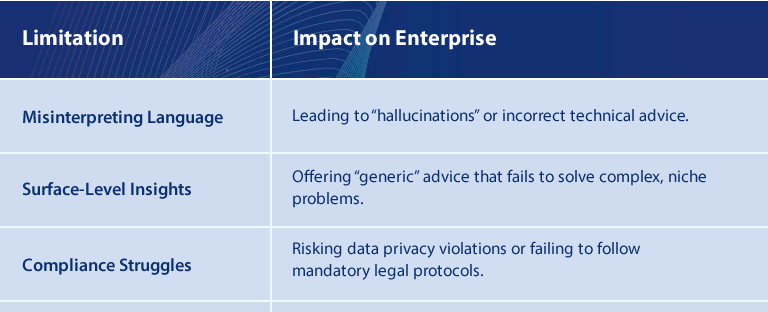
While general-purpose Large Language Models (LLMs) are undeniably powerful, their broad training on public data often leaves them ill-equipped for the rigorous demands of enterprise environments. In high-stakes industries such as healthcare, finance, legal, and manufacturing, generic models frequently fall short because they lack the precision required for specialized operations. These models often struggle with compliance-sensitive tasks, provide only surface-level insights, and can dangerously misinterpret domain-specific language. Consequently, there is a growing shift toward Domain-Specific Large Language Models (DSLLMs), which are engineered to navigate the unique regulatory, terminological, and contextual complexities that general AI simply cannot master.
Key Requirements for Enterprise Success
To function effectively in professional sectors, an AI must move beyond general conversation and master these four critical areas:
- Deep Contextual Understanding: This goes beyond simple pattern matching. It involves understanding the nuance of a specific business case, historical data, and the subtle “why” behind professional workflows.
- Industry-Specific Terminology: Every field has its own shorthand, jargon, and acronyms. A model must know, for example, that “liquid” means something very different to a chemist than it does to a hedge fund manager.
- Regulatory Awareness: In heavily regulated sectors, an AI must operate within the boundaries of laws like HIPAA, GDPR, or specialized financial codes to ensure every output is compliant and low-risk.
- Structured Reasoning: Enterprise tasks often require multi-step logic and adherence to strict professional methodologies rather than just creative or probabilistic text generation.
Table: The Constraints of Generic LLMs in Practice
Without specialization, standard LLMs often encounter the following roadblocks:
What Are Domain-Specific LLMs?
Domain-Specific LLMs are AI models tailored to a particular industry or business function. They go beyond vocabulary—they internalize the logic, workflows, and decision frameworks unique to a domain. Instead of being “generally intelligent,” they are professionally intelligent. By focusing their training on curated, high-quality proprietary data rather than the entire open internet, these models offer a level of precision and reliability that generic counterparts cannot match.
The Business Value of DSLLMs
The business value of Domain-Specific Large Language Models (DSLLMs) lies in their ability to bridge the gap between “interesting technology” and “indispensable business tools.” By narrowing the focus, these models solve the specific friction points that often prevent general AI from being deployed in production.
- Precision That Drives Better Decisions
By training on curated, domain-relevant datasets, DSLLMs generate outputs that align with industry standards—whether it’s a financial report, clinical summary, or legal document. This high-fidelity output ensures that the model acts as a true expert assistant rather than a generalist that requires constant oversight. - Trust and Reliability
In enterprise environments, accuracy isn’t optional. DSLLMs reduce hallucinations and provide responses grounded in domain knowledge, increasing stakeholder confidence. This reliability is critical for maintaining professional integrity when AI-generated insights are used to influence high-value corporate strategies. - Built for Compliance
From healthcare regulations to financial governance, DSLLMs can be aligned with industry-specific compliance frameworks, reducing risk. They provide a safer operational environment by adhering to strict data handling protocols and ethical guidelines inherent to specialized fields. - Cost-Efficient Scalability
Compared to large general models, smaller specialized models offer a leaner path to digital transformation:
(a) Reduced Computing Requirements: Because these models are more focused, they require significantly less computational power and energy to process complex queries.
(b) Accelerated Deployment: Specialized models are often faster to deploy because they require less “prompt engineering” to reach an enterprise-ready state.
(c) Higher ROI for Targeted Use Cases: By solving specific business problems with high accuracy, they deliver a much faster return on investment than broad, expensive AI initiatives. Ultimately, this efficiency allows organizations to scale their AI capabilities across multiple departments without the prohibitive costs associated with massive, general-purpose infrastructures. - Superior User Experience
Professionals prefer tools that “speak their language.” DSLLMs enable more natural, efficient interactions—whether for analysts, doctors, or legal teams. By eliminating the need for users to explain basic industry concepts, these models foster a seamless “human-in-the-loop” workflow that feels intuitive to the expert user.
How Enterprises Build Domain-Specific Intelligence
There is no one-size-fits-all approach to building an AI that understands your business. Instead, organizations typically adopt a layered strategy, choosing the right combination of techniques based on their specific needs for speed, depth, and accuracy.
The Technical Roadmap
- Prompt Engineering: Fine-tuning the way, we interact with models can guide general LLMs toward domain-specific outputs without changing the underlying software. This method is fast and cost-effective, serving as an excellent starting point for basic tasks. However, it is fundamentally limited in depth; you can only “coach” a generalist so much before they hit a wall of specialized knowledge.
- Retrieval-Augmented Generation (RAG): Real-Time Intelligence RAG is the bridge between a model’s training and your company’s private data. By connecting models to live enterprise data sources, RAG enables up-to-date responses and source-backed outputs that provide greater explainability. This ensures the AI isn’t just “guessing” based on old data but is referencing your actual, current documents.
- Fine-Tuning: Fine-tuning or deep specialization involves taking a model and training it further on a specific dataset so that domain knowledge is embedded directly into its “brain.” This enables better reasoning, consistent output formats, and tight alignment with business context. It is the gold standard for when a model needs to master a highly technical or proprietary language.
- Hybrid Models: The most sophisticated enterprises don’t choose just one; they combine the best of both worlds – fine-tuning with RAG. This hybrid approach ensures the model has the deep, inherent expertise of a specialist while maintaining the real-time relevance provided by live data connections.
Key Success Factors for Implementation
Building a DSLM is not merely a technical exercise; it is a strategic initiative that requires a solid foundation. Success depends on more than just code.
- Data Readiness is Critical: High-quality, structured, and governed data is the essential foundation of any AI project. Without clean data, even the most advanced models will underperform or, worse, provide misleading insights. Organizations must prioritize data hygiene before they can expect AI excellence.
- Domain Experts Are Essential: While AI models learn from data, they are refined by humans. The role of subject matter experts (SMEs) is indispensable for validation, annotation, and evaluation. These experts ensure that the AI’s logic aligns with real-world professional standards.
- Start Focused, Then Scale: The most successful implementations begin with a narrow, high-impact use case. By focusing on a specific workflow, a defined dataset, and a measurable outcome, teams can prove value and iron out kinks before scaling the technology across the broader organization.
- Continuous Evaluation: Unlike generic AI benchmarks that measure general fluency, DSLMs require a human-in-the-loop evaluation process. This ensures that the model remains accurate and contextually relevant as industry regulations or business goals evolve over time.
Industry Applications: Where DSLMs Deliver Impact
We are already seeing DSLMs revolutionize how high-stakes industries operate by providing precision where general models fail.
- Healthcare: These models power clinical decision support, medical summarization, and patient communication, ensuring every output is grounded in medical accuracy and safety.
- Financial Services: In finance, DSLMs excel at risk analysis, sentiment tracking, and automated reporting, processing complex data with deep financial context that generic models miss.
- Legal: Legal teams utilize DSLMs for contract analysis, legal research, and case summarization, relying on the model’s ability to provide structured reasoning and pinpoint citation accuracy.
- Manufacturing & Engineering: By integrating with simulation tools and operational systems, these models drive intelligent automation and sophisticated decision support on the factory floor.
Strategic Implications for Enterprise Leaders
The move toward DSLMs represents a fundamental shift from experimentation to AI-driven transformation. Forward-looking organizations are no longer just “playing” with AI; they are investing in domain-focused data strategies and exploring smaller, deployable models that offer greater cost control. By embedding AI into core business workflows—not just side use cases—leaders are aligning their AI initiatives with revenue growth, customer experience, and operational excellence.
How Helios Solutions Enables This Transformation
At Helios Solutions, we help enterprises transition from generic AI adoption to precision-driven AI ecosystems. With deep expertise in AI/ML and data science, combined with our specialized solutions like Sol BI, we provide a clear path to intelligence. We help you unify siloed data across systems, deliver actionable and context-aware insights, and enable conversational AI that truly understands your decision-makers. Our focus is simple: turn AI into a strategic business advantage rather than a technological experiment.
The Future Is Specialized…
The era of “one-size-fits-all AI” is coming to an end. Domain-Specific LLMs represent the next phase of the digital revolution. A phase where AI is not just intelligent, but relevant, reliable, and business-ready. For enterprises aiming to lead their industries, the question is no longer whether to adopt AI, but how precisely to tailor it to the unique demands of their domain.
As the landscape matures, the true winners will be those who treat their proprietary data as a strategic asset rather than a storage challenge. By moving beyond general-purpose models, organizations can finally unlock the full potential of automation without compromising on security or accuracy. This shift toward specialization ensures that AI becomes a seamless extension of the human workforce, capable of navigating complexity with professional-grade nuance. Ultimately, the transition to DSLLMs is about more than just better software; it is about building a foundation of trust that allows AI to take a seat at the executive table.